James Webb Telescope
About
Overview
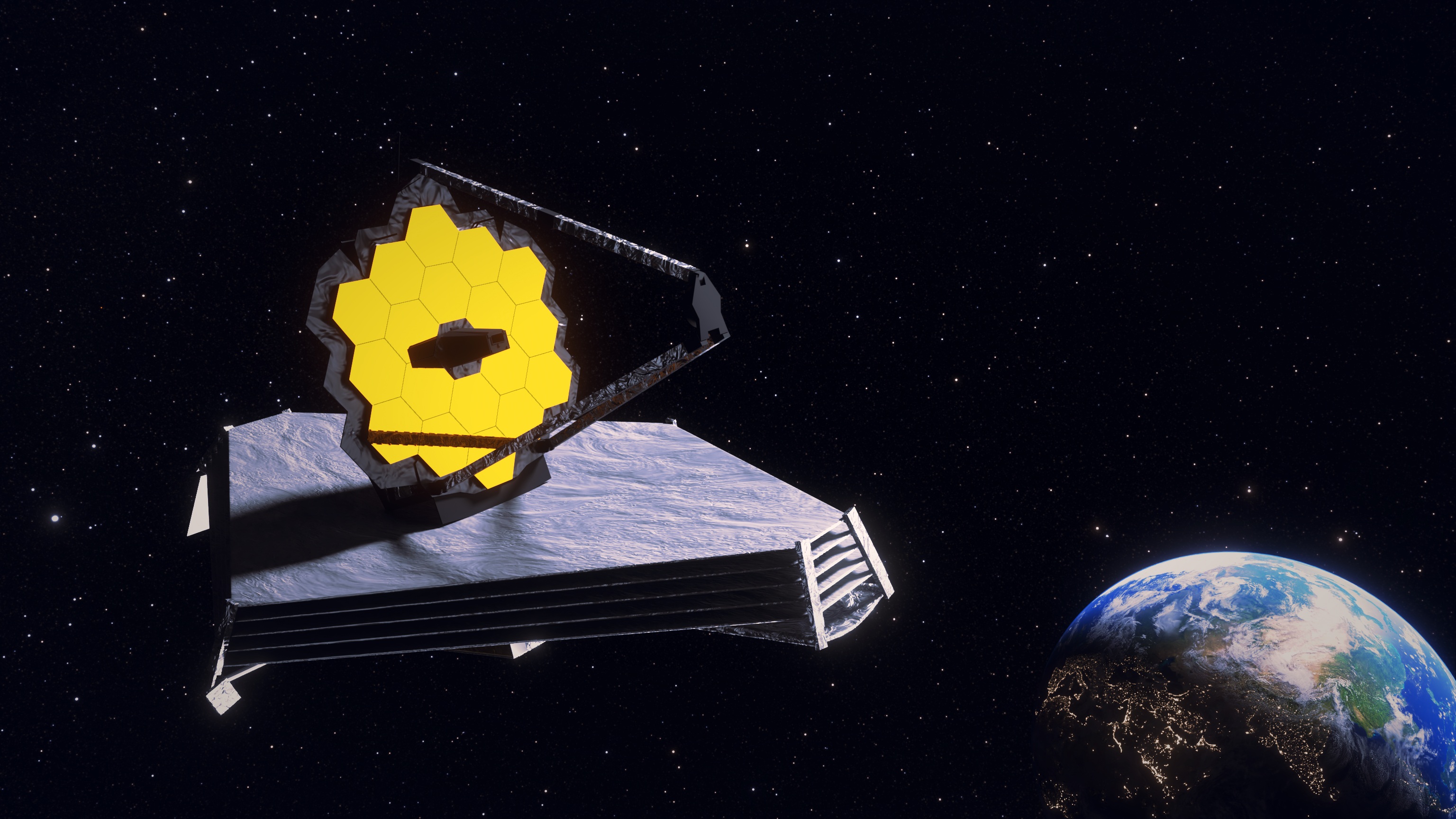
Launched in 2021, the James Webb Space Telescope is the largest and the most powerful space telescope ever built by NASA. It is equipped with high-resolution infrared instruments, a giant golden mirror and sunshield, allowing us to view old, distant and faint objects.
Mission objectives
- Observe into the farthest reaches of the known universe
- Search for the first stars after the big bang
- Search for potential life on distant planets
- Study our own solar system and distant ones
- better understand how planets, stars and galaxies are born and evolve over time
Features
- Golden mirror: Webb has a 6.5 meter-diameter gold coated beryllium primary mirror, made up of 18 separate hexagonal mirrors.
- Sunshield: Because of the suns intense heat, Webb has a sunshield about the size of Three yellow school buses to protect the sensitive instruments.
- Instruments: Webb has four scientific instruments onboard
- NIRCam (Near Infrared Camera) is an infrared imager
- NIRSpec (Near Infrared Spectrograph) performs spectroscopy over the same wavelength range
- MIRI (Mid-Infrared Instrument) measures the mid-to-long-infrared wavelength length
- FGS/NIRISS (Fine Guidance Sensor and Near Infrared Imager and Slitless Spectrograph), stabilizes the line-of-sight of the observatory during science observations.
- High frequency radio transmitter: To communicate and transmit data back to Earth
Location
Webb is located in a point of space know as Lagrange 2, or L2 for short. L2 is located 1.5 million kilometers behind the earth, away from the sun.
The reason for choosing this location is because it has an unobstructed view for Webb to look deep into space. It is an extremely stable location where Webb will continuously be aligned with the earth and have stable temperatures. Finally because L2 remains fixed relative to the earth, it will have constant communication with no black out periods.
 A Novice Riders Adventure